
Modern enterprises generate the sheer volume of data every day through a transaction, click, and sensor reading. This data holds the key to competitive edge, however, many organizations fail to leverage it because of slow and siloed BI systems. Such old BI systems give outdated reports and insights. An advanced enterprise analytics framework can fill the gap between data potential and outcome by delivering high-impact insights.
This comprehensive guide on modern analytics framework shows its key components, trends, and roadmap for effective implementation. Let’s start with the importance of modern data platforms for enterprises.
Why Enterprises Need a Modern Analytics Framework
Many enterprises find it difficult to cope with increasing data volumes in this competitive scenario. This makes the transition to a modern data platform a necessity. Here are five reasons companies opt for data analytics framework-
Data Silos
Today, enterprises face the data fragmentation issue. In other words, data is scattered everywhere ranging from monolithic ERP systems to CRM and cloud applications. This fragmentation makes it impossible for companies to get a holistic view.
Slow Decision-making
Outdated reporting cycles and manual processes are too slow to keep the pace with this digital age. By the time a decision-maker receives an insight, the company may have missed the opportunity. Therefore, companies need proactive approach.
Need for Real-time Insights
In highly competitive and regulated sectors, it is imperative to make decisions in milliseconds, not hours. Whether it is fraud detection or supply chain optimization, real-time insights always play a crucial role in addressing this requirement.
Demand for Speed
Sales leaders to marketing specialists cannot wait for the IT department to generate necessary reports. Therefore, self-service analytics capabilities are essential to explore data and answer immediate questions of both these teams.
Increasing Competition
Organizations need to make insightful decisions in real time to remain competitive in this challenging scenario. As the data analytics platform offers the necessary insights in real time, companies can address increasing competition.
A feature-rich enterprise analytics framework provides companies with the essential structure, governance, and a scalable approach. This is useful for converting data streams into immediate and valuable business insights.
Key Components of a Modern Analytics Framework
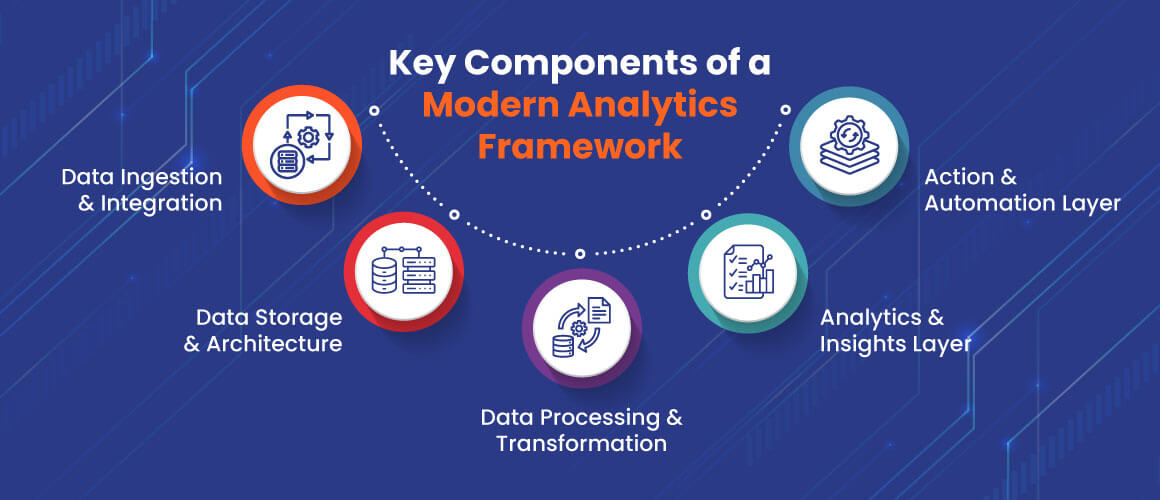
A sophisticated and high-performance modern data analytics framework has five interconnected components that deliver actionable insights by working together. Here are these five layers-
1. Data Ingestion & Integration
This foundational layer can gather data from all sources across your enterprise. It connects diverse sources, including ERP systems, CRMs, cloud applications, and IoT devices. This component also supports traditional batch loading and real-time analytics through streaming. It uses advanced tools or platforms like Kafka to decouple source systems from the central platform.
2. Data Storage & Architecture
This is basically a combination of a data warehouse (for structured data) and a data lake (for unstructured data)that forms a data lakehouse. This component is a place for data to reside and optimize for cost and query performances with the help of cloud or hybrid infrastructure. Emerging organizational concepts like Data Mesh have emerged that decentralizes data ownership and delivery to domain-specific teams.
3. Data Processing & Transformation
This is a crucial component that converts raw data into reliable and modeled data ready for consumption. It utilises robust ETL (Extract, Transform, Load) or ELT (Extract, Load, Transform) pipelines. This is beneficial for cloud-native services or open-source frameworks. This component or layer focuses on essential tasks like data cleansing, modelling, and enrichments to create trusted insights for enterprises.
4. Analytics & Insights Layer
It is the interface or dashboards that enables business users to interact with the result of the enterprise analytics framework. It combines machine learning and AI for predictive and prescriptive analytics. This component offers high-end visualization tools for facilitating self-service BI (Business Intelligence). Moreover, it integrates critical insights directly into operational systems for instant visibility.
5. Action & Automation Layer
This is a final layer that turns insights into automated and measurable actions. It triggers alerts and notifications automatically as per predefined data thresholds. It integrates with operational applications, business processes, and RPA to automate responses. Furthermore, this layer ensures that the data analytics architecture delivers measurable ROI through real-time actions.
As technology evolves, these layers or components get more advanced through innovative trends. Let’s dig deeper into some of these trends.
Modern Trends Shaping Analytics Frameworks
The speed at which businesses expand increases data complexity significantly. Therefore, several key trends are necessary to consider for utilizing modern data platforms.
Real-Time Analytics
The latest analytics frameworks have streaming architectures that enable organizations to process data in motion. This results in instant decision-making for fraud detection and operational adjustments.
Self-Service Analytics
This type of platform empowers businesses to explore data and generate insights without depending on the IT team. This strengthens the decision-making process and nurtures a data-driven culture.
AI-Augmented Insights
AI and ML technologies combine to give a rise to AI-augmented approaches. This can increase the efficiency and depth of analysis significantly and automates tasks like data preparation, detecting anomalies, etc.
Cloud-Native Analytics
The transition to the cloud offers high scalability and elasticity. Modern data governance frameworks are cloud-native that offer quicker deployment, automatic scaling, and immediate access to cutting-edge tools.
Apart from these trends, two other concepts are gaining ground. One of them is Edge analytics that brings processing power closer to the data source for enabling ultra-low-latency decisions. Another is Data Mesh principles that promote decentralized data ownership and consumption. However, it is essential to ensure an effective implementation of enterprise analytics framework to leverage the benefits of these trends and features.
Effective Implementation Roadmap for Enterprises
Implementing an analytics framework is a transformational process. You need to focus on business value and other considerations to ensure the effective implementation of a scalable modern data platform. Here are five steps that can help you make a roadmap of implementation-
Assess Your Analytics Maturity
You can start your implementation journey with an honest and comprehensive evaluation of existing analytics capabilities. This assessment can help you identify the pain points and areas of improvement.
Identify High-Value Use Cases
It is better to focus on 2 to 3 use cases initially to get the highest and most visible ROI. You can choose either customer churn prediction or automated alerting for supply chains to secure executive buy-in.
Choose Right Data Architecture
You need to select the physical layout first. It should serve the best for your use cases. You can choose either a consolidated data warehouse, a flexible data lakehouse, or a decentralized Data Mesh as per your business requirements.
Establish Governance and Ownership
A robust data governance framework plays a vital role in establishing governance, responsibilities, and ownership. It helps you define clear roles and establish data quality standards effectively.
Start at Small Scale
Finally, you can implement high-value use cases first to demonstrate tangible success. In the second stage, you can include more departments and expand to advanced AI models for better insights.
This is not all! You should consult a reputable data analytics solutions provider to make a roadmap for successful implementation and address challenges.
Major Implementation Challenges & Solutions
Even if a robust and proper implementation strategy is in place, a modern data framework requires addressing some common challenges to maximize the ROI. One of these challenges is poor data quality. It leads to incorrect insights and reduction in the user’s trust. Companies can implement automated data quality checks and validation rules to address this challenge.
Lack of governance is another big challenge. If data governance is not proper, decentralized data leads to conflicting metrics and increases the risk related to regulatory compliance. A sophisticated data governance framework can help companies address this challenge.
Moreover, introducing too many disparate tools without any cohesive data analytics architecture can generate new silos. A cloud-native data lakehouse architecture can address this challenge. Businesses should invest in high-quality training and self-service analytics interfaces to increase the adoption rate of analytics frameworks.
Concluding Remarks
A modern data analytics framework is essential for any enterprise to remain competitive in this digital age. It drives transformation by offering real-time analytics to make faster decisions. However, it is necessary to implement the right data analytics architecture and establish data governance policies to leverage the benefits of this framework. An experienced data solutions provider can help you transform data assets into advantage.
Silver Touch Technologies is a leading data analytics solutions provider. We assist a global corporate clientele to leverage the benefits of data to drive growth and transformation. Our in-house team of experienced professionals supports enterprises in building or modernising data analytics framework. Contact us to learn more about our data solutions and services.
FAQs
What is a modern data analytics framework for enterprises?
A modern data analytics framework is a structured approach that unifies data ingestion, storage, processing, analytics, and automation to deliver real-time, actionable insights for enterprises.
Why do enterprises need a modern analytics framework?
Enterprises need a modern analytics framework to overcome data silos, speed up decision-making, access real-time insights, and stay competitive in fast-changing business environments.
What are the key components of an enterprise analytics framework?
The main components include data ingestion, data storage and architecture, data processing, analytics and visualization, and an action-and-automation layer.
What modern trends influence enterprise analytics frameworks?
Key trends include real-time analytics, self-service analytics, AI-augmented insights, cloud-native analytics, edge analytics, and emerging data mesh principles.
What challenges do companies face when implementing a modern analytics framework?
Common challenges include poor data quality, lack of governance, tool overload, and low user adoption—each requiring governance, validation, and proper architecture to resolve.